Saturday, 12 July 2014

Planting / 2013-2014 / Bloody Butcher Corn

Last year, one of the crops I grew was Bloody Butcher corn. The seed was bought from Koanga. I started it out in trays on the front porch under frost cloth, and eventually planted it out. And finally, I harvested the remaining cobs for seed, which has since dried and been stored away. A few of these earlier pictures may have already been posted, but not the rest.

This was late October 2013, or Spring here. You can see the three sisters bed, with the corn mounds, and the planted out seedlings on each. It looks nice and lush.

Corn, Bloody Butcher - 01 - 2013-10-28 - 03

A close up of the same bed on the same day, showing the planted out seedlings. Note that I don't know math good, so grew too few seedlings. One of my many mistakes.

Corn, Bloody Butcher - 01 - 2013-10-28 - 04

Mid to late December 2013. The seedlings have grown. Also the hills without seedlings either had seeds direct sown, and where they didn't germinate, new seedlings grown and transplanted. A variety of "squash" or pumpkin as they are known here, the second of the three sisters, are interplanted. Most of these were germinated in trays and transplanted. Direct sowing didn't work out well in general. The third sister, beans, is in there in some cases, on the corn hills. But again miscounting of numbers required affected them.
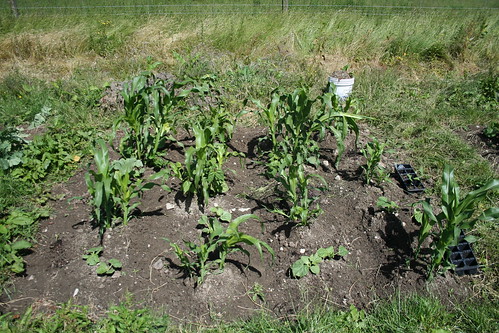
Corn, Bloody Butcher - 01 - 2013-12-22

Early January 2014. More seedling growth, both of the pumpkin and corn. The shade of the corn seen here, is indicative of the problem with three sisters in a non-desert environment. I simply don't get the heat and sunlight to make the shade beneficial. In a desert environment, the shade would prevent water evaporation. In a summer with lots of mist, fog and plenty of rain.. it meant sodden ground and insufficient sunlight to underlying plants instead. Lesson learned.

Corn, Bloody Butcher - 01 - 2014-01-10

February 2014. What a difference 20 days makes. The front right corn shows what happens after strong winds knock down stalks. They pull themselves back up.
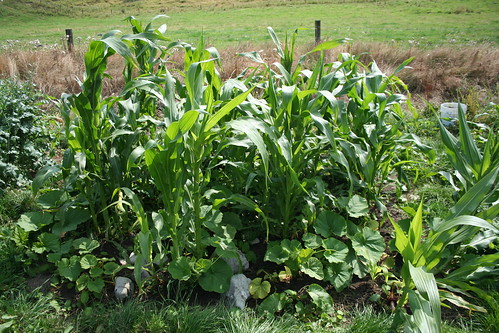
Corn, Bloody Butcher - 01 - 2014-02-01 - 01

March 2014. The corn has passed the sweetcorn stage, but is not showing any signs of drying off. Too many mild days. One of the more developed cobs has been peeled back to encourage it to dry. When dried, the bloody butcher kernels are a deep red colour.
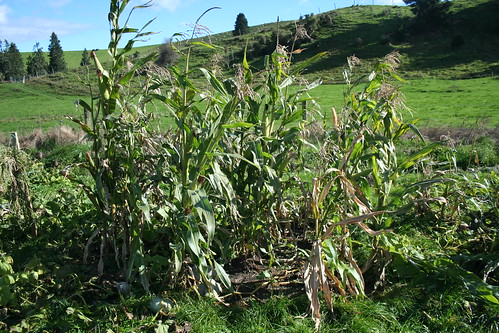
Corn, Bloody Butcher - 01 - 2014-04-29 - 01 - Front

Early April 2014. All the remaining cobs have been peeled back. At this stage it was evident that birds wouldn't touch the existing peeled back cob, so it was safe to do it to the rest. As long as the cobs are past a certain stage, the frosts will not do any real harm. This I learned from some internet research.
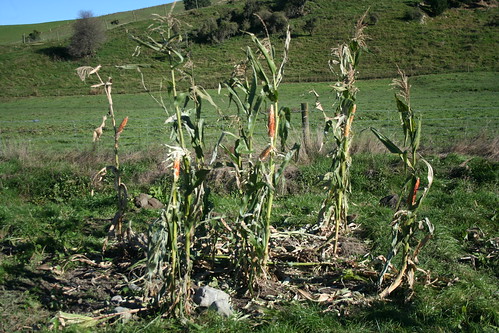
Corn, Bloody Butcher - 01 - 2014-05-06 - 01

Late April 2014. Here you can see that several frosts have happened, killing off the stalks. The cobs are pretty dry, but none are fully dry. All are soft to some lesser degree at this point. Perhaps one has a floury texture to the matter inside it's kernels.
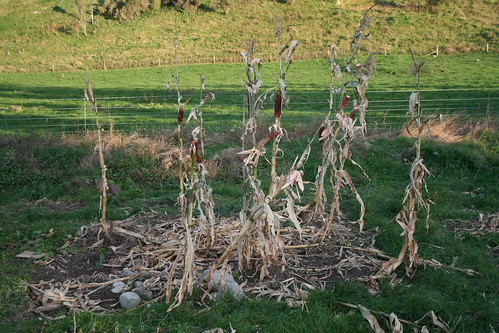
Corn, Bloody Butcher - 01 - 2014-05-28 - 01 - Drying

The lesson learned from all my corn growing, is that three sisters does not make sense here. Also, do not plant different varieties of corn side by side, unless you want cross-pollination. Many of my Bloody Butcher cobs sported kernels which had traits of kernels on the Blue Aztec and Black Navajo varieties grown alongside them.

Tuesday, 17 June 2014

IncursionScript & the Accent compiler compiler

When I started working with the Incursion source code, which Julian released, one of the problems was that not all the source code was available.  The bulk of the game data, both for d20 elements and dungeon generation, is specified in scripts.  These "IncursionScript" files are compiled into a module, which Incursion can have more than one of.

The problem was that they are compiled using the Accent compiler compiler.  And Julian had a version of this, which had been custom modified to produce C++ compatible code, but no longer had the source code.  I downloaded the original Accent source code and proceeded to try and get it working.

The Accent tool takes a ".acc" file, and transforms it into ".c" and ".h" files which you can compile against.  But it is also generated source code, created using some tool called Gentile.  The correct way to do this, which it appears Julian also avoided, would be to modify the Gentile grammar for Accent, and to generate a new version.  Instead, the approach we both took was to modify the generated Accent source code.

Accent is old school C code.  Seldom having return types in it's own source code, and rarely producing return types in the code it generates.  Occasionally using uninitialised stack variables, and expecting the value to be NULL.  And it generated argument typing for function declarations the other way, where rather than including the type with the argument name in the parenthesised list following the function name, the variable is redeclared fully (in the same way as stack variables) following that list and preceding the function body.

function(argname1, argname2, argname3)
    int argname1;
    char *argname2;
    void *argname3;
{

It is really the fixing of these three things that makes Accent C++ compatible, rather than making it output C++ specific elements.  In any case, a modified version of the Accent source code is now checked into the Incursion repository.  This is built as a dependency of the main Incursion project, ensuring that if there are any grammar changes, then they are rebuilt as needed.

Wednesday, 7 May 2014

Corn predators & ripening

As the time to harvest corn for seed has come, I've noticed that some of the Blue Aztec, has been eaten by something.  The chickens are too dumb to know to peel back the corn to get to the kernels.  What has eaten the corn?  Rabbits?  Hares?  Magpies?  Something else?


It must be something ground-based.  Here's a Bloody Butcher cob which I peeled back, which is perhaps 1.5 meters off the ground.  I figured that pulling back the husk on this cob would serve a few purposes.  Firstly, if there were birds eating it, they'd easily find it and have a go.  And secondly, I'd be able to see if it would make a difference in ripening it from a yellow colour to the dark red it should be when dried.  It's been exposed for a week, and has gained some redness as can be seen.


The Bloody Butcher gave consistently big cobs.  Most of them are still on the stalks, as few have ripened sufficiently.  I'm not sure how well they'll do in the frosts.  And I'm not sure if they will ripen, or produce viable seed, if I tear them all out and dry them in the shed.