Showing posts with label hugelkultur. Show all posts

Monday, 8 September 2014

More Hugelkultur Garden Beds

In an ideal world, all my garden beds would have been prepped last Autumn. But it was cold and wet, and.. it never happened. So at the start of Spring, I've been digging out and clearing some more hugelkultur beds where my corn patches used to be.

This is the paddock hugelkultur bed #2. Most of the soil here was taken out, mixed with a ute load of purchased compost, and put in a raised bed by the house. Filling with wood and then covering with soil followed this photo.
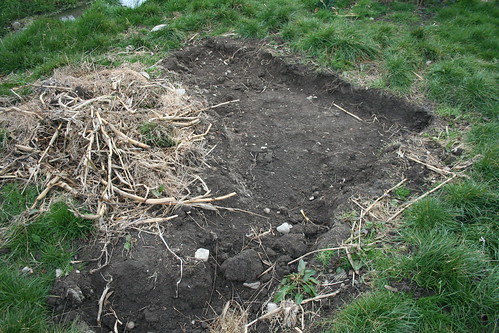
Garden Bed Preparation - Field - 2014-08-13

A later photo, showing newly dug and filled paddock hugelkultur beds #2 and #3, and beyond that fenced #1. The bordering with cardboard was intended to catch dirt while working, and is not a good approach long term in my opinion. The grass grows around it and pushes it up. You can also see clearing in preparation for subsequent beds closer to the camera.
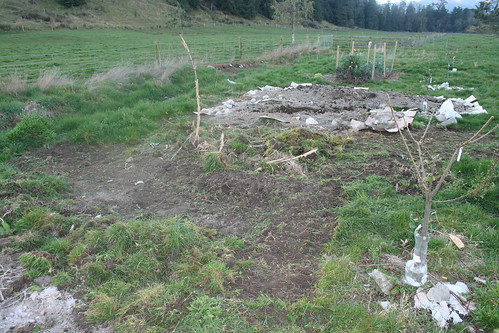
Garden Bed Preparation - Field - 2014-09-02 - 05

Three ute loads of wood from the neighbours "burn piles", ready for digging #4. You can see borage growing in the back right corner of the pile, this is one of the few things that I can identify as having grown from the Koanga herbal ley seeds I scattered last year (and never saw any sign of).
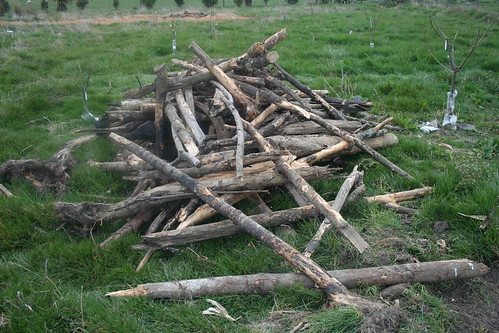
Garden Bed Preparation - Field - 2014-09-05 - 01

The easy part of #4 dug out, where it overlaps the past year's corn patch. The intention is to make it longer where I have the space. #3 has a plum or quince tree planted beyond the corn patch area, which is why it ends up shorter.
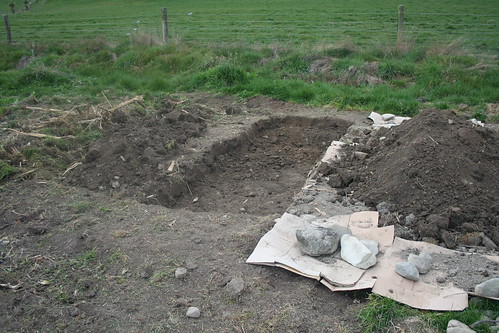
Garden Bed Preparation - Field - 2014-09-05 - 02

#4 filled in with wood, and with a partial dirt covering. It by this point was dug out to an extended length.
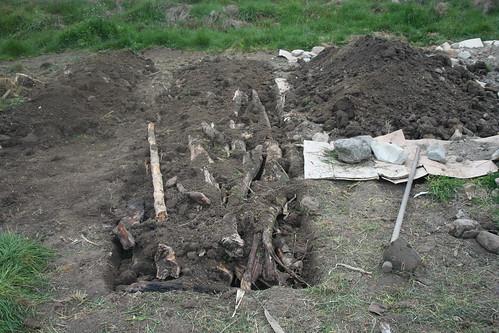
Garden Bed Preparation - Field - 2014-09-05 - 03

And finally the finished #4 bed. Note that #3 still has an excess of soil from where wood in #4 displaced it, this will be shared between all the beds.
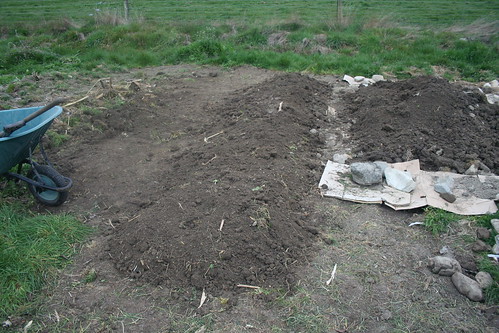
Garden Bed Preparation - Field - 2014-09-05 - 04

It takes maybe three hours to do this, but most of the work is already done because the soil in the past year's corn patches has been previously dug up. Parts like the extended area have never been dug, and are hard and contain stones making them much more work.

Friday, 2 May 2014

My first raised bed

It gets pretty wet here, and it saturates my current garden beds.  In order to avoid that problem in future, I've decided to go with raised beds.  I dug out this section to a depth of around 50cm.  It promptly rained and filled the bed.  Then I bailed it out, and took this photo.


At this point, I got in there and dug it all out some more.  Then the chickens jumped in with me and got in the way.  Next I threw in all the large logs I have, some horse chestnuts I'd picked before learning they were toxic, leaves, old sheep manure, cow manure, collected newpapers and junk mail, half composted.. compost, chicken manure and a variety of other things that would break down.

The dug out soil was claggy from having too much clay in it.  So I mixed in potting mix, sheep manure,  and cow manure.  This made it a little better.  And once placed back on all the filler I had in the hole, made a pretty decent raised bed.  For mulch I popped up onto the neighbours hill and grabbed some dried pine needles.

And here's the result.  It's planted out with broccoli, leeks, silverbeet and cabbage.  Something's already had a bite of the leaves, but I'm pretty sure it's not the chickens.  Since adding the pine needles, there are already earthworms crawling about under them.  As I was planting it out, the chickens were trying to stretch through the netting and pick them out.  Thankfully they've forgotten about it for now.


I should probably note that I dug extra top soil out of where the wood chips are, which contributed to the height of the raised bed, and declaggified the clay somewhat.  The chickens occasionally peck away at the Red Russian kale to the left of the picture, but aren't really that partial to it.   Why all the crap under the dirt, apart from raising the bed up?  Because it's hugelkutur, the idea being the logs break down over time and turn into good soil.  But in the duration, they hold water.