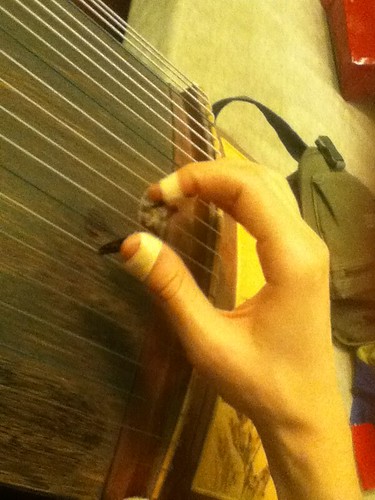
Broken gǔzhèng strings
This post is intended to record what I have learnt about tuning my gǔzhèng (古筝), and sourcing new strings in New Zealand.
When you transport your gǔzhèng, you remove the bridges to prevent the strings from breaking if weight is placed on them. The next time you want to play it, you replace the bridges and retune each string.
Replacing the bridges and tuning the strings, I snapped three of the higher ones (1, 6 and 7). These are the thinnest, and are more likely to break. With my bad tuning technique, I think some of the lower strings are also damaged but are thankfully still usable and whole.
When you transport your gǔzhèng, you remove the bridges to prevent the strings from breaking if weight is placed on them. The next time you want to play it, you replace the bridges and retune each string.
 |
| Gǔzhèng bridges |
 |
| Tuning knobs and strings |
The best solution would have been to find suitable strings in local music stores. I tried two local stores and it became clear this wasn't something they dealt with ever. The first store was staffed by a Chinese lady who knew what I was talking about, and later called to suggest looking in one of the many local Chinese newspapers for gǔzhèng teachers as they often sell parts or instruments (as teachers also do in China). The second showed me a selection of strings for other instruments that might be suitable, but we concluded they weren't and they kept my number in case they located any. When they later called back, they had found a local teacher who would sell individual strings at $5 NZ a piece.
In the meantime, I had ordered and received several sets (a full 21 piece, and two sets of 1-10 strings) from a store in the USA called Sound of Asia. This came to about $70 NZ including shipping, and was much cheaper than buying from a local teacher would have been given the price above. It also arrived extremely quickly, within 3-4 days of ordering.
 |
| Sound of Asia sourced strings |
With the new strings and a desire not to have to order more, I had researched (and learnt in the practice of doing this) some guidelines to follow when replacing the bridges:

- Bridge placement: Use the tuning chart from the Sound of Asia web site, which illustrates best bridge placement for each string. You can see white tape on the left side of my gǔzhèng, in the first picture. This is where I've measured and marked each of the distances.
- String fitting: There's a trick to properly winding the new string onto it's tuning knob. Wind the string around the knob several times before pushing the end of the string through the hole. If you do not do this, then you'll run out of tightening room before your strings are tightened enough.
- String tuning/tightening: When turning the tuning knob for a given string tighter, take the string off the bridge, tighten and then having done that replace the string on the bridge.
I've included the tuning chart below, as I am unable to locate it on the Sound of Asia site any more.

Good luck! And here's a YouTube video of someone playing Richard Marx's Right Here Waiting on one of these instruments, just for the sake of it. I've got to learn more about music so I can try playing some western songs.