Shanghai water delivery
I found this in my drafts folder. Have I already posted a version? Beats me, but between my cold and my desire to go to bed.. I'm going to assume I haven't and just post it.
---
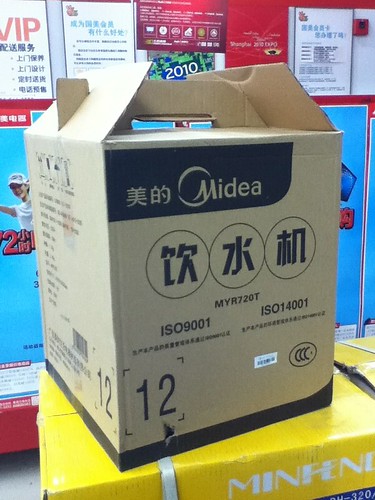
If you're drinking water in Shanghai, you have several options. You can boil the tap water to kill the germs and drink that, but then you still have the heavy metals. You can buy bottles from the supermarket, but then you're killing the environment with all that discarded plastic and it gets old carrying the bottles home. And you can also obtain or buy a water dispenser and have 5 gallon bottles delivered to your home.
I'm at the point where I am buying a water dispenser. The word on Shanghai Expat was that you can get one for around 100 RMB at a store like Gome. So I located my nearest Gome store on Changshou road and went there.
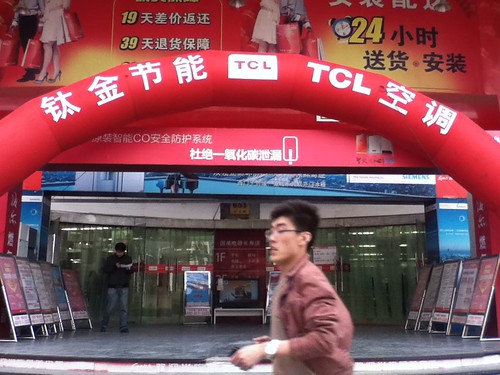
The process of buying something at a store like these, let alone a water dispenser, is long and complicated. You start off buy going to find the good you want on the shelf, then you negotiate in limited Mandarin with all the old ladies standing around. Then one of them goes off and fills in a form, and gives it to you. Then you head up stairs to the payment counter, and pay the girls there. Then they give you two slips, one of which (the white one) is to give to the collections counter and the other (the pink one) is your fa piao / receipt.
So you head over to the collections counter, where someone takes the white slip and goes to fetch whatever you bought.
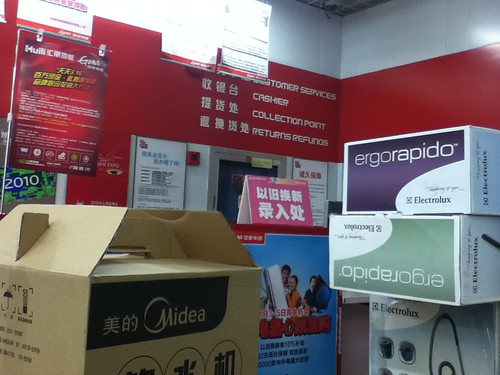
Then you grab it and leave.
The next step is to get the water bottles to accompany it. On Shanghai Expat people seem to talk about preferring three brands mostly. Nongfu Springs, Watsons and Nestle. Nongfu Springs is a local cheaper brand, but no-one seems to talk about getting it delivered. I normally drink Nestle, so I decided to stick with it and order that. After a bit of Googling, I managed to find a Chinese language Nestle web page. Life must have been so much harder for people living in China before tools like Google Translate were around.

There are three types of water offered. Distilled at 28 RMB, mineral water for 19 RMB and purified water at 17 RMB. It is kind of confusing which to choose, but Shanghai Expat comes to the rescue again. People advise against the distilled water because it lacks the minerals and salts of normal water, which causes problems in the long run. The word is to buy mineral water.
So I called the listed number, pressed 2 for English. Then gave my address, named how many bottles I wanted, agreed to pay a 40 RMB deposit for each, chose which type of water I wanted and they will be delivered tomorrow between 12 PM and 5 PM. It is not exactly ideal to have to stick around home for five hours!
I've since left Shanghai, and didn't bother getting the ~40 RMB refund per bottle. The Nestle delivery service was consistently helpful, and went out of their way to get me the water. If they came at the wrong time, or when I popped out, they'd ring and sort out a new time. I'd recommend anyone living in Shangai use them. Many of the locals simply boiled the water, maybe that's good enough for you.. but maybe you should think twice.


