Showing posts with label broad beans. Show all posts

Monday, 3 October 2016

Rhubarb, berries, pear tree, broad bean landrace and comfrey

I've made another video taking note of things that I've not recorded, or have visibly changed. This will be quite helpful in keeping track of things like having a visual record of which pear is which on the double-grafted one.  You can't trust the nurseries and orchards and should check these things yourself, I've had several instances where they've botched things.  And also noting the traits of individual varieties of broad bean in the landrace as they cross-pollinate from year to year.

It's another foggy Spring morning. The fog actually lifted earlier, and the sun was so low I almost had to close the blinds so I could work. The grass and dock have taken off in the past two weeks, as has the rhubarb.  I'm going to have to clear the grass before making movies, or taking photos, as it is quite hard to see some things that are growing amongst grass.

I increased the quality the phone camera was recording, and used a weight to try and stablise the camera from shaking.  In this case I basically sat the phone sideways on the rock and held it there, carrying it around.  It seemed to make a difference, but wasn't perfect.


Wednesday, 21 September 2016

Grafting fruit trees, and various things growing

Going back to my old photos, I find it's often difficult to make out the things that were the reason I took the photo anyway.  Like which tree is which.  And it's just so much work, that I am also finding that I am not doing the things I should do, like note what trees are pollinating at the same time - so as to work out why one tree has not fruited.

So this is the first video that catalogs the progress of things.  It starts with my garlic, then some fruit tree grafts, then the Green Mountain potato onion and finally some more fruit tree grafts.  It makes sense to do weekly fruit tree flowering videos, so I can have a visual record of how well things that are supposed to pollinate each other sync up.  Although they won't be posted, if I do post any videos it'll mostly be ones that do a general overview, or concentrate on progress of certain projects.

This is a shakey video, as it's the first one I've made.  It is intended to catalog all the grafting I've done in the past couple of weeks, so that if the tags are lost, I'll know what is grafted where.  In the past I've used photos for this, but oftentimes they're actually little help and I have little idea what tree I am looking at.  I wonder if someone else owns this property in the far future, if they still have the orchard, whether the videos will still be available for them to work out what is planted where.


I mention Koanga quite a bit for the grafts.   Less than half the scion wood came from Koanga.  The rest was traded with people on the internet for various varieties of scion wood I have here, and other things.

Wednesday, 11 May 2016

Broad bean (Fava bean) landrace year two

I was originally planning to plant garlic in most of these beds, but garlic ideally goes in on the shortest day of the year which I think is still a month away.  Broad beans however, when planted in the Autumn, are I am told best sprouted and a couple of inches high by the first frosts.  But not high enough to flower.  Last year I think I got them a bit late, and the odd seed popped out of the soil as the frosts hit them.

All of these beds are pre-existing ones, except for the one on the right with the stones alongside it.  Those stones came out of the ground as I was digging it.  There are two rows of two bean varieties in the two larger beds (front right and front left), and one row of two varieties in each of the three long beds behind.

The beds were not amended with anything other than a covering layer of home-made compost, and were prepared solely by breaking up the soil after removing the grass/weeds that had grown over them since Spring or whenever whatever was in them was harvested.  Two beans are planted together at each spot along each row, and the weakest will be either transplanted or discarded.  I used the English RHS planting recommendations, which I think were 60cm between double rows, and around 23cm between each of the rows in the double rows, and 20 cm between each planting in along a row.

Broad bean, Landrace - 2016-05-04 - 01 - Beds prepared and planted'

The selection criteria for now is whatever grows best, given no fertilisation other than the compost.  And as this is the second year all these varieties (around 10) have been grown alongside, there should ideally be some visible sign of cross-pollination.  Of course, they were completely neglected last year, so hopefully there was some cross-pollination.  In any case, I came out of last year with more seed than went into it, so it wouldn't be a complete loss if cross-pollination between varieties is poor.

I'm hoping to find the time to get a paint brush and hand-pollinate maybe the first five plants in each row, perhaps as a limited but doable experiment that doesn't require too much time investment.

Saturday, 10 August 2013

Winter planting

What can I plant in winter?  I have no idea.  But there are websites, like GardenGrow, which claim to tell me what I can plant.  That raises more questions, like is my property temperate or cool/mountain zoned? I have no idea. It does link to tiny pictures that delineate whereabouts in the country the different zones could fall into, not that I could ever work out where my property falls on them.  Still, no idea.  Oh well, apparently there are some "no brainer" crops.

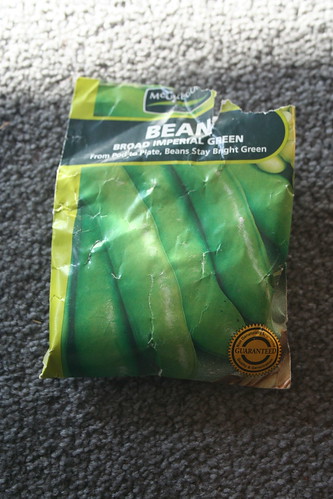
Broad beans.  These are apparently something anyone (this means me) could grow.  I planted these Sunday, 9th of June.  No idea where this packet was bought, or how much it cost.  Planting involved in simply pushing one of the hard seeds down a few centimetres in two rows in one of my raised beds.

2013-08-06 - Farmlet - 10 - Broad bean variety Broad imperial green packet

Garlic.  This packet of Printanor was bought at New Zealand's equivalent to Walmart, called The Warehouse.  The price is visible in the photo, at $5.99.  Initially I planted the cloves on June 14th from this packet as two rows right beside the broad beans.  The thick end was pushed down, leaving the pointy end of a clove upright.  There were conflicting descriptions of how deep to plant them, so I went for pushing them down around 1.5 centimetres.  I've been told that if you don't push them down far enough, and a frost happens, then the cloves could pop out of the soil.
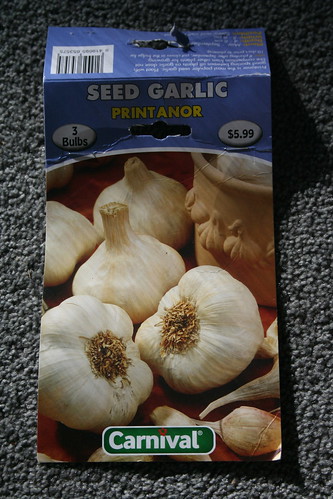
2013-08-06 - Farmlet - 08 - Garlic variety Printanor packet

After two weeks or so, I researched enough to be able to have confidence in the claim that garlic doesn't go with legumes (which broad beans are) and that unless I moved them, they'd likely be detrimental to the beans. So on June 18th I dug up every clove, and moved them to the far side of the raised bed.  Is it far enough?  I don't think anyone knows, and if they do, they don't bother to write it down.  On the bright side, the garlic had sprouted and it was great to know that something was growing.

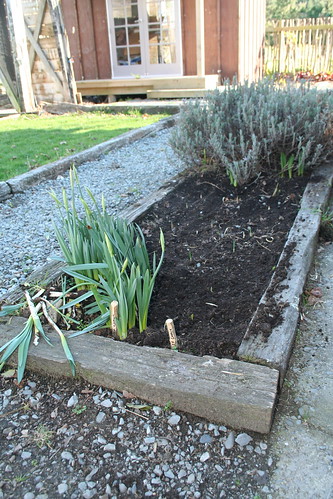
I was also given a packet of garlic bulbs which were from a local spray-free business.  These were planted in a flower bed just outside my front door.  This is the photograph just below with the green bulbs coming up in the front.  You can see the bulbs I've pulled out from amongst the garlic, in order to prevent they from getting in the way of the garlic growing and getting whatever nutrients it needs.  You can actually see the garlic green bits (no idea what the correct term is!) here popping up to about 1-2 centimetres in height.  This is growing much better than the "The Warehouse" garlic.  That could also be due to the move which the "The Warehouse" garlic had to put up with, though.

2013-08-06 - Farmlet - 02 - Flower bed garlic

I've been doing quite a bit of damage to this flower bed, and in the process have had to try and tell the bulbs which were coming up from the garlic which was coming up.  The garlic seems pretty well rooted in, which is a good sign.

The following photo is the raised bed with the "The Warehouse" garlic still not above the soil on the right, and the broad beans visible on the left having just come up a week ago.  There's an olive tree in the back corner, and to the left of it, is a walnut.  Now here's another documented gardening problem, which isn't documented well enough to be useful.  All parts of a walnut tree are supposed to exude something called juglones.  Juglones supposedly "harm other plants".  This walnut has been shedding it's leaves and nuts into this raised bed for years.  How should I factor this juglone problem into using the raised beds below it?  Maybe this type of walnut is a kind which doesn't exude juglones?
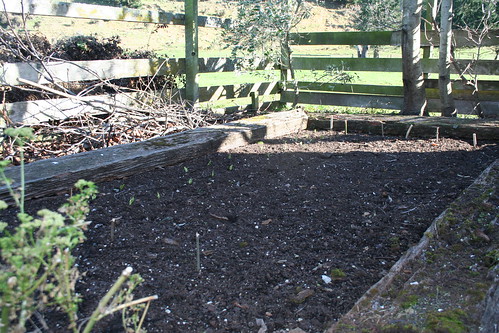
2013-08-06 - Farmlet - 03 - Raised bed garlic

It's the first week of August now, and after a snow storm which missed this part of the district, followed by a week or so of heavy wind, the weather has been unseasonably mild.  Plants are flowering, and trees have begun to bud.  I'm told there are further frosts likely to come, and that will equally likely damage anything fooled into thinking it's spring already.

All this should just take care of itself.  The broad beans I'll have to stake, so that they can climb up, at some point.  The garlic I'll have to do some further research on, both to work out when they will be ready, and what I would do if I wanted to leave them to go to seed.  I think it takes around six months for garlic to come up, if I recall correctly.  The olive tree.. I really need to do some research to work out whether if I move it out into the paddock, whether that will kill it.