Showing posts with label fruit trees. Show all posts

Monday, 3 October 2016

Rhubarb, berries, pear tree, broad bean landrace and comfrey

I've made another video taking note of things that I've not recorded, or have visibly changed. This will be quite helpful in keeping track of things like having a visual record of which pear is which on the double-grafted one.  You can't trust the nurseries and orchards and should check these things yourself, I've had several instances where they've botched things.  And also noting the traits of individual varieties of broad bean in the landrace as they cross-pollinate from year to year.

It's another foggy Spring morning. The fog actually lifted earlier, and the sun was so low I almost had to close the blinds so I could work. The grass and dock have taken off in the past two weeks, as has the rhubarb.  I'm going to have to clear the grass before making movies, or taking photos, as it is quite hard to see some things that are growing amongst grass.

I increased the quality the phone camera was recording, and used a weight to try and stablise the camera from shaking.  In this case I basically sat the phone sideways on the rock and held it there, carrying it around.  It seemed to make a difference, but wasn't perfect.


Wednesday, 21 September 2016

Grafting fruit trees, and various things growing

Going back to my old photos, I find it's often difficult to make out the things that were the reason I took the photo anyway.  Like which tree is which.  And it's just so much work, that I am also finding that I am not doing the things I should do, like note what trees are pollinating at the same time - so as to work out why one tree has not fruited.

So this is the first video that catalogs the progress of things.  It starts with my garlic, then some fruit tree grafts, then the Green Mountain potato onion and finally some more fruit tree grafts.  It makes sense to do weekly fruit tree flowering videos, so I can have a visual record of how well things that are supposed to pollinate each other sync up.  Although they won't be posted, if I do post any videos it'll mostly be ones that do a general overview, or concentrate on progress of certain projects.

This is a shakey video, as it's the first one I've made.  It is intended to catalog all the grafting I've done in the past couple of weeks, so that if the tags are lost, I'll know what is grafted where.  In the past I've used photos for this, but oftentimes they're actually little help and I have little idea what tree I am looking at.  I wonder if someone else owns this property in the far future, if they still have the orchard, whether the videos will still be available for them to work out what is planted where.


I mention Koanga quite a bit for the grafts.   Less than half the scion wood came from Koanga.  The rest was traded with people on the internet for various varieties of scion wood I have here, and other things.

Tuesday, 28 June 2016

Planting out persimmon seedlings

Two summers ago, back in September 2014, I saved and planted out two persimmon seed from the local supermarket.  I scarified them in the refrigerator over the preceding Winter, and put them in these two pots.

Persimmon Seed - 01 - 2014-11-03 - 02 - Germination
September 2014
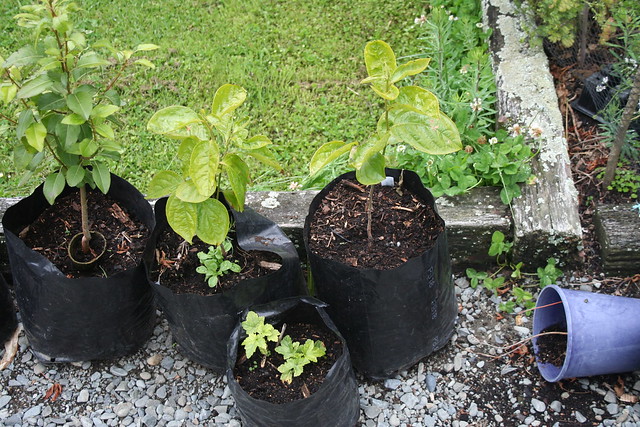
When they grew too big for the pots, I put them in planter bags and lost them amongst a whole clutter of seedlings on the North side of the house.  Eventually, they were rediscovered, identified and put in another clutter of seedlings.

Persimmon - 2015-12-31 - Seedlings
December 2015
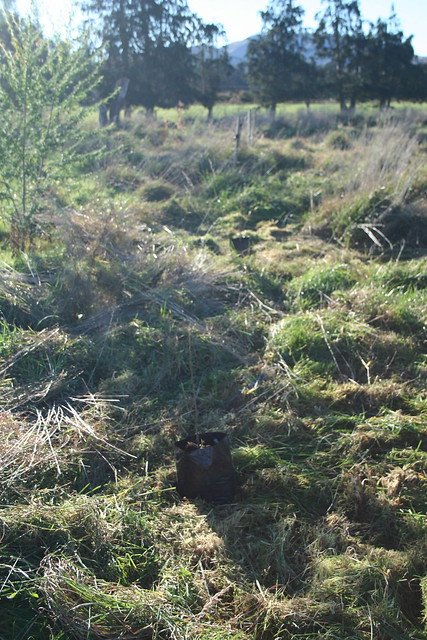
Now that the leaves have dropped from them, I decided to plant them out.  First step was clearing the thick clumps of grass along the selected orchard row.  In the distance, you can see blurry in the background what looks like stakes.  There are two existing persimmon trees there, perhaps 1.5m tall each.   In the foreground is one persimmon seedling in the planter bag, and between the distant stakes and the foreground persimmon you can perhaps see a second persimmon seedling in another planter bag.

Persimmon, seedling - 2016-06-24 - 01 - Pre-planting
June 2016
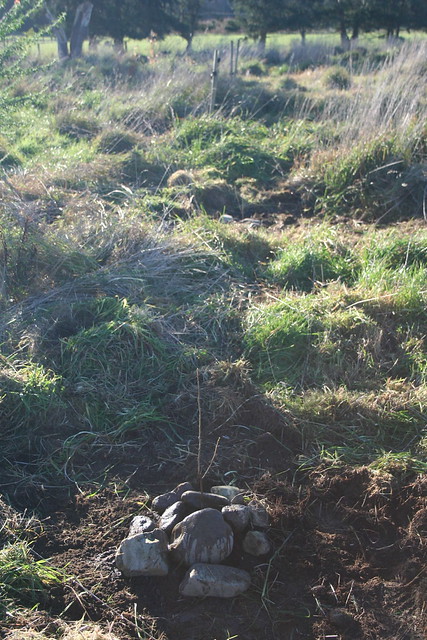
And here they are planted out.  The older staked persimmon trees are more clearly visible in the background, and the midway seedling can be made out by the stones surrounding it.

As I finished planting these out the chickens came over and started scratching around them.  The stones tend to prevent them from doing any damage, or digging anything out that's just been planted.

Persimmon, seedling - 2016-06-24 - 02 - Post-planting
June 2016

Monday, 27 June 2016

Winter pear

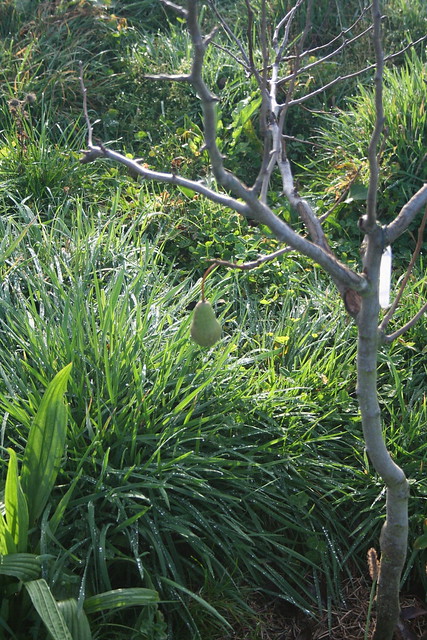
In late Autumn, the Packham's Triumph pear tree flowered in one location and one of these flowers has since pollinated against.. well, I have no idea.  Since then, at the start of Winter, it has gotten down to almost 0°C at least once and there have been white frostings on the ground, but the lone pear keeps growing.

Pear, Packham's Triumph - 2016-06-27 - Winter fruit

Wednesday, 22 June 2016

Scionwood Exchange

In New Zealand, have fruit trees or bushes and can graft cuttings or wanting to try?

I'm exchanging cuttings from my fruit trees this Winter, with some other interested people who have their own selection of fruit trees/bushes.  If you're googling for scions/cuttings for grafting in New Zealand and have your own selection to exchange, please comment and we'll get in touch.

Here's my exchange list for Winter 2016:

  • Almond - Monovale
  • Apple - Granny Smith
  • Apple - Montys Surprise
  • Apple - Peasgood Nonsuch
  • Apple - Splendour
  • Apple - Cider - Brown's Eater
  • Apple - Cider - Kingston Black
  • Apple - Cider - Lady Finger Cider
  • Apple - Cider - Yarlington Mill
  • Apricot - Cluthagold
  • Apricot - Moorpark
  • Apricot - Royal Rosa
  • Apricot - Unknown (older tree)
  • Cherry - Lapin
  • Fig - Brown Turkey
  • Fig - French Sugar
  • Grape - Albany
  • Mulberry - Black
  • Nectarine - Fantasia
  • Nectarine - Goldmine
  • Olive - Frantoio
  • Peach - Black Boy
  • Peach - Golden Queen (from seed)
  • Peach - Yellow (Unknown, mislabeled Black boy from nursery).
  • Peach - Flatto (still need to look at tree to see if can take cuttings).
  • Pear - Packham's Triumph
  • Pear - Winter Nellis
  • Pear - Taylor's Gold
  • Plum - Black Amber
  • Plum - Coes Golden Drop
  • Plum - Greengage
  • Plum - Hawera
  • Plum - Prune - Italian
  • Plum - Santa Rosa
  • Plumcot
  • Quince - Smyrna
  • Walnut - Unknown (decent sized nuts, reliable bearer).
Bushes for grafting or rooting cuttings:
  • Citrus, Grapefruit, Golden Special.
  • Currant, Black, Magnus.
  • Currant, Black, Cotswald Cross.
  • Currant, Red, Unknown (mislabeled White Currant from Mitre 10)
  • Currant, Red, Unknown (unlabeled from nursery).
  • Currant, Red, Gloria de Versailles.
  • Gooseberry, Invicta.
Roots and other things:
  • Artichoke, Jerusalem.
  • Comfrey, roots.
  • Garlic, Takahue Red.
  • Yacon.

Monday, 19 October 2015

Orchard apricot trees in Spring 2015

I've planted three apricot trees in the orchard, a Royal Rosa, a Moorpark and a Cluthagold.

The Royal Rosal flowered first, at the same time as the older apricot tree.  Unfortunately, while I covered it along with the later flowering trees with frost cloth, a heavy frost occurred on a night when no-one was here to cover it and none of the flowers survived.  Last year one apricot ripened on this tree.

2015-10-17 - Royal rosa
Royal Rosa apricot tree
The Moorpark is the next oldest orchard planting.  Flowering later than the Royal Rosa the nightly coverings of frost cloth started in time, and it has the most young green apricots on it.

2015-10-17 - Moorpark apricot tree
Moorpark apricot tree
Lastly, is the Cluthagold tree which was planted within the last year.  It also has a decent number of young green apricots on it, considering.

2015-10-17 - Cluthagold apricot tree
Cluthagold apricot tree
All the grass has been cleared from around the apricot trees and a layer of mulch put down.  People say (like robots) that the reason for any problem is the grass is not having been cleared from around the trees, but lets look at the facts.

  1. If the grass is cleared from around the trees, the lack of rain dries out the soil and cracks the ground.
  2. When the long grass is cleared from around the trees, the trunk is often wet despite lack of watering or rain.  Likely from the dew.
To me, the belief that the grass is bad seems to be a religious one.  I think it does more help than harm.  I'd put a photo of some of the cracked ground here, but it just rained this morning for the first time in ages and it won't look as convincing as it would if I had taken a picture yesterday or a day from now.

Saturday, 17 October 2015

The old apricot tree in Spring 2015

At time of purchase, this property had one old diseased apricot tree, a walnut tree and a black boy peach.

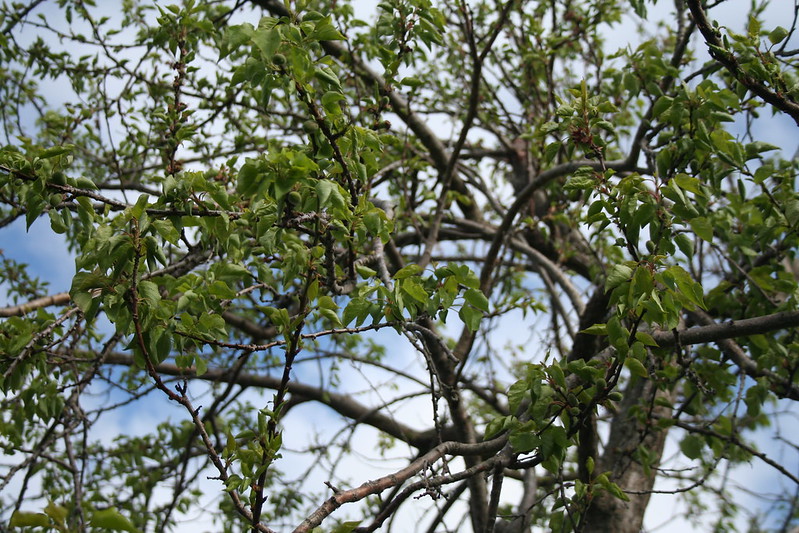
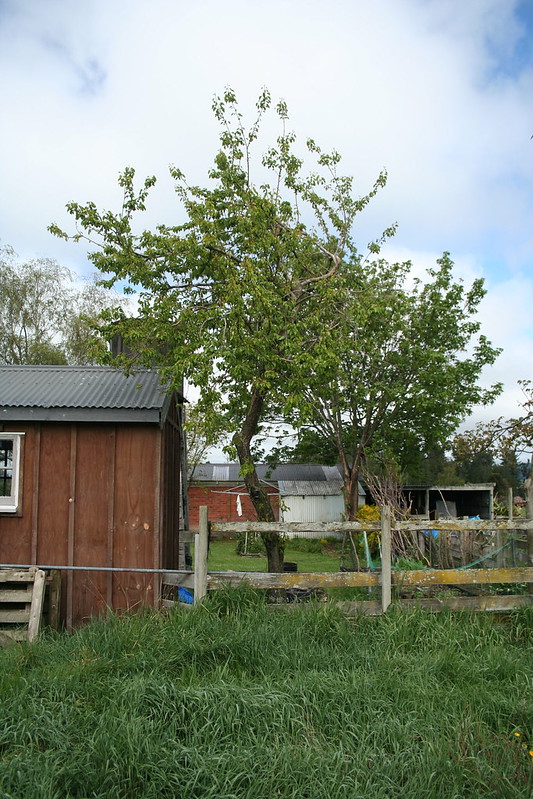
This tree below is an unknown variety of apricot, and to the left of it out of frame is the walnut tree.  The walnut tree has fruited well every year, and in the cupboard I've both jars of walnut in form suitable for cake decoration and also pickled in malt vinegar.  The apricot however, was rather lacklustre and provided about five albeit tasty fruit last year.  In the photo below it can be see seen flowering, it flowered early and suffered little effect from the weeks of frosts which followed.

Old apricot tree at start of spring

The next picture is three weeks on, and while it's hard to make them out, it is covered in young green apricots.

Old apricot tree first fruit photo

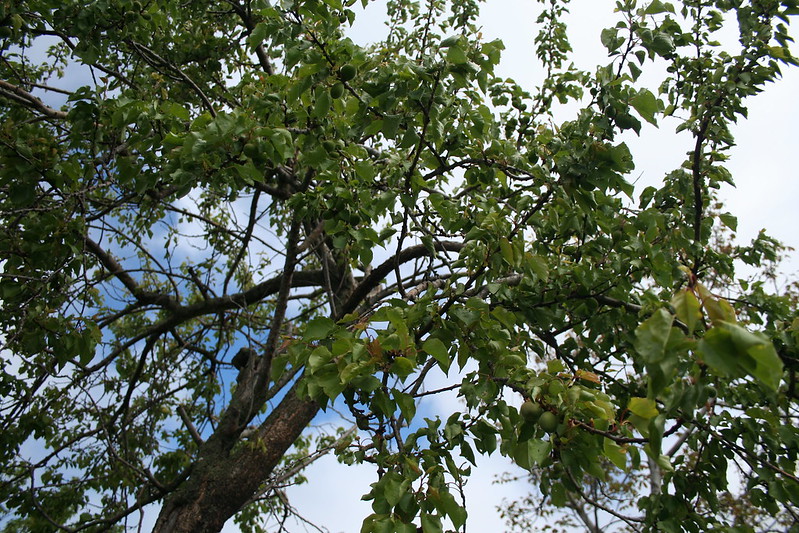
Here's the tree four weeks on, note that behind it to the right is a sycamore tree.  This is the only real place I've seen bees this Spring and even then only yesterday.  Seriously.  I've been out in the paddock daily looking around, and while there might be the odd bumblebee, mostly it's flies that seem to be pollinating the flowers.

Old apricot tree second fruit photo 3

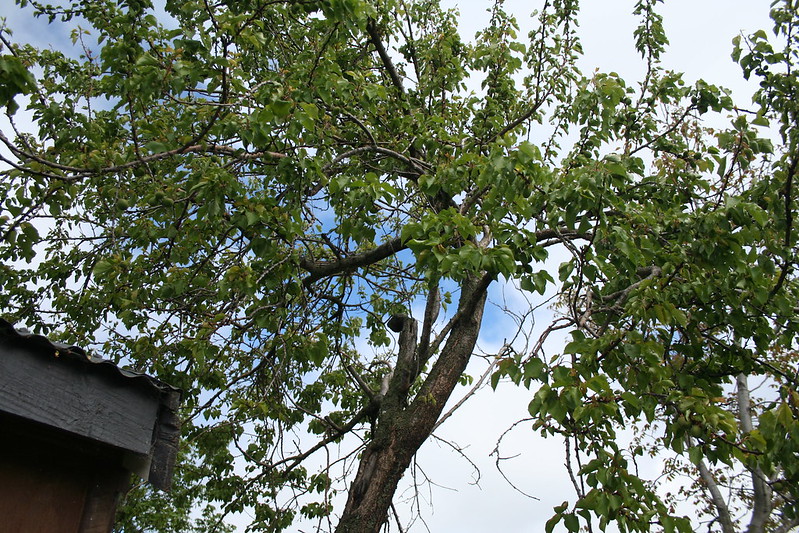
This is a close up of the tree at four weeks on.

Old apricot tree second fruit photo 2

And another.

Old apricot tree second fruit photo 1

This year is looking good for apricots.

Tuesday, 19 August 2014

Peach, Black Boy, #1 / 2013-2014

There were two unknown fruit trees planted around the house. One was in the garden by the hut and it was obviously a dwarf nectarine or peach. The other was in the front garden, and was obviously not a dwarf tree, but was also a nectarine or peach. The only way to find out what kind, was to wait and see, as a peach is a fuzzy nectarine.

Day X+0: By this stage, I'd pruned the tree, and we were into summer and leaves had grown along with small fruit. There's not much to say past this point, other than to observe the growth over the 2/3 of a year that passed. I did thin out the fruit at one point.

Peach, Black Boy - 01 - 2013-11-08

Day X+6:

Peach, Black Boy - 01 - 2013-11-14

Day X+44:

Peach, Black Boy - 01 - 2013-12-22

Day X+66:

Peach, Black Boy - 01 - 2014-01-13

Day X+69:

Peach, Black Boy - 01 - 2014-01-16

Day X+76:

Peach, Black Boy - 01 - 2014-01-23

Day X+85:

Peach, Black Boy - 01 - 2014-02-01

Day X+99:

Peach, Black Boy - 01 - 2014-02-15

Day X+114:

Peach, Black Boy - 01 - 2014-03-02

Day X+141:

Peach, Black Boy - 01 - 2014-03-29

I would have gotten around 10 fruit from the tree. Some mornings I would go out and pick up the windfall fruit, but if I forgot, either rabbits, hares or more likely blackbirds would have taken a bite or three out of them. The chickens at this stage were caged away, but love pecking away at black boy peaches.

Sunday, 3 August 2014

Appleton's Nursery Delivery

Last year's big purchase of plants was all my fruit trees. I've now got around 40 trees out in my orchard. This year's big purchase are two kinds of more practical trees, and something I bought on a whim.

I came home on Monday morning to find a package the postie had left at my gate. I keep the gate closed because, as I've probably mentioned before, South Neighbour's fence isn't too great. This means that if my gate is open, I get cows or sheep in my front yard, and at worst, in my back yard and field. This is a problem because they tend to do things like eat whatever I have planted around, including my citrus. My grapefruit is still recovering.

Delivery, Appleton's Nursery - 01 - 2014-07-17 - 01 - Packaged

The packaging is quite solid. There is a whole covering of plastic, inside a whole covering of very sturdy paper.

Delivery, Appleton's Nursery - 01 - 2014-07-17 - 02 - Unwrap

The inner plastic bag helps keep the roots wet, as the trees have to be bare rooted to ship this way. Note there are 80 bare rooted plants in all packaged into this.

Delivery, Appleton's Nursery - 01 - 2014-07-17 - 03 - Unwrap

There are 20 sugar maple (acer saccharum), 50 hazelnut (corylus avellana) and 10 black chokeberry (aronia melanocarpa).

Delivery, Appleton's Nursery - 01 - 2014-07-17 - 04 - Bare rooted Sugar Maple, Hazelnut, Black Chokeberry

For now, I've heeled them in wet sawdust. This will help kill off the remaining odd leaf, and let them survive dormant, until the weather comes a bit better so I can plant them out.

Regarding the sugar maples, there was an article about someone up in Nelson who planted a lot of these out 20 years ago, and how they're just coming ready to harvest maple syrup from. And any time you mention them, you get some 'negative nancy' who says how you need a certain amount of frost which I wouldn't likely get, to be able to get maple syrup from them. They're an experiment for me. A recent article detailed a way in which you can get maple syrup sooner, and with less required frosts.

The hazelnuts might produce decent nuts. But they will be seed grown, which makes that not a certain thing. So, it'll be a source for coppiced wood. And I'll also have the opportunity to graft known varieties of hazelnut to them, once they've grown to a decent size.

The chokeberry. Well, I'd read a bit about them in some book or on some web sites, around the time I ordered. I don't remember why I ordered them, but they should add a nice bit of variety to the berry orchard. I'd probably have around 25 berry plants, in addition to the 40 fruit trees mentioned earlier. It's also not likely to be common, so I should be able to trade it for other plants or varieties of plants I already have, at a later point once I've rooted some cuttings.

Monday, 28 October 2013

Weather

This is a picture from the first bout of heavy wind, now over a month and a half old. That knocked out the power for a day or so, where I live. It also left a local bridge that I use blocked, requiring me to do a long detour.

2013-09-13 - Wind damage - Fallen tree

Pretty much every day, these days, has some strong wind. But about two weeks ago, there was another bout of bad weather. It started by in the space of ten minutes going from a sunny day, to dark and windy, to heavy hail, and finally back to a sunny day. I was by my garage shovelling potting mix and planting new seeds in new seed trays, so had to hurry to put some protection over my existing seed trays.

2013-10-13 - Wind damage - Hail - 01

The front lawn. The peach tree near the center of the photo, which had minor blossom on it, didn't get too badly damaged. It currently has lots of fuzzy buds on it.

2013-10-13 - Wind damage - Hail - 03

The eucalyptus tree part of the front lawn (Sunday).

2013-10-13 - Wind damage - Hail - 02

The eucalyptus tree part of the front lawn (Monday). This is after the second bout of wind.

2013-10-14 - Wind damage - Eucalyptus branch

There's an old apricot tree by my raised beds. I didn't think there were many budding fruit on it as it was, but after the wind, there are now even less.

2013-10-14 - Wind damage - Apricots

The power went off early in the morning, so I decided to drive into town and take care of some business. Unfortunately, my preferred route was blocked.

2013-09-14 - Wind damage - Fallen tree road blocked - 01

My second preferred route was also blocked.

2013-09-14 - Wind damage - Fallen tree road blocked - 02

And more power lines were down.

2013-09-14 - Wind damage - Power lines down

Thankfully the power came back on shortly before I actually left for town, and although it went off for several hours later in the afternoon, it's been on since. The eucalyptus tree blocks the winter morning sun, and it's not near enough to anything other than shrubs, to do much damage if more pieces fall off. Here's hoping for no more power cuts.

Sunday, 15 September 2013

Cider apple tree delivery

Most of my plant purchases are what I consider investments. I don't expect to be able to do anything with them in the near future, but the fact that they are in the ground means that eventually they'll be ready to do something with. And sooner, for being in the ground this winter, in the case of bare root trees.

This order was from Thunder Mountain Nursery in the north island. It was driven by an interest in having cider apple trees, so that's what most of them are.  I don't know if I've posted these particular details, so I'll cover it here.  They tend to arrive bundled together.

In this case, the order was:

  • Kingston black cider apple tree.
  • Brown's Eater cider apple tree.
  • Lady Finger Cider cider apple tree.
  • Yarlington Mill cider apple tree.
  • Italian Prune plum tree.
There was some logic applied in the choice of cider apple trees.  At some point I read that you need a variety of different trees, so that you can blend the apples.  So maybe one is sweet, another bittersweet, another bitter.. whatever.

2013-08-20 - Thunder mountain trees - 01 - Delivery
As delivered.
In the bag, the roots are I assume kept moist by either sphagnum moss or straw.  And it was straw in this case.

2013-08-20 - Thunder mountain trees - 02 - Packaging
Straw packing.
Here's a look with the trees taken out.

2013-08-20 - Thunder mountain trees - 03 - Unpacked
Unpacked.
My current process is to fill buckets with diluted seaweed extract, and to soak the trees for 24 hours before planting.  But I've only recently become more disciplined in how I do this, and so I didn't do it for these.

Here is the planted row.  My evolved square edging is now my standard approach.  One problem with it, is that the grass tends to grow back.  I need to start sheet mulching, and I'd like to widen the edged space but there is one main problem with that.  The problem is that this is a slope coming downhill in my direction, as seen in this photograph.  So a wider edged area will allow the water to spread more.

2013-08-21 - Thunder mountain trees - 01 - Planted row
The planted row.
At this point, I am dreading all the apples I am going to have.  Even the idea of feeding them to the horses next door is starting to become appealing.

Monday, 9 September 2013

Mystery trees

On my property, there are two relatively new trees that I think are fruit trees.

This tree looks very similar to dwarf peach trees that you can see in the nursery sections of local stores.  I don't think I've seen dwarf nectarines, so it's probably a pretty safe bet.

2013-08-15 - Mystery plants - 01 - Maybe nectarine or peach
Dwarf peach tree?
The leaves on this tree looked like the leaves I've seen on nectarine trees.  I'll have to wait and see.  But really, if they were the same leaves, from what I understand it could be nectarine or peach as they are both the same family.

2013-08-15 - Mystery plants - 02 - Maybe nectarine or peach
Nectarine or peach?